
CASE STUDY — REPUTATION MANAGEMENT
The throne wasn’t mine
A live case study documenting the work to reclaim my own search results — in real time, on the hardest possible case, with the chronicle accumulating below as the work proceeds.
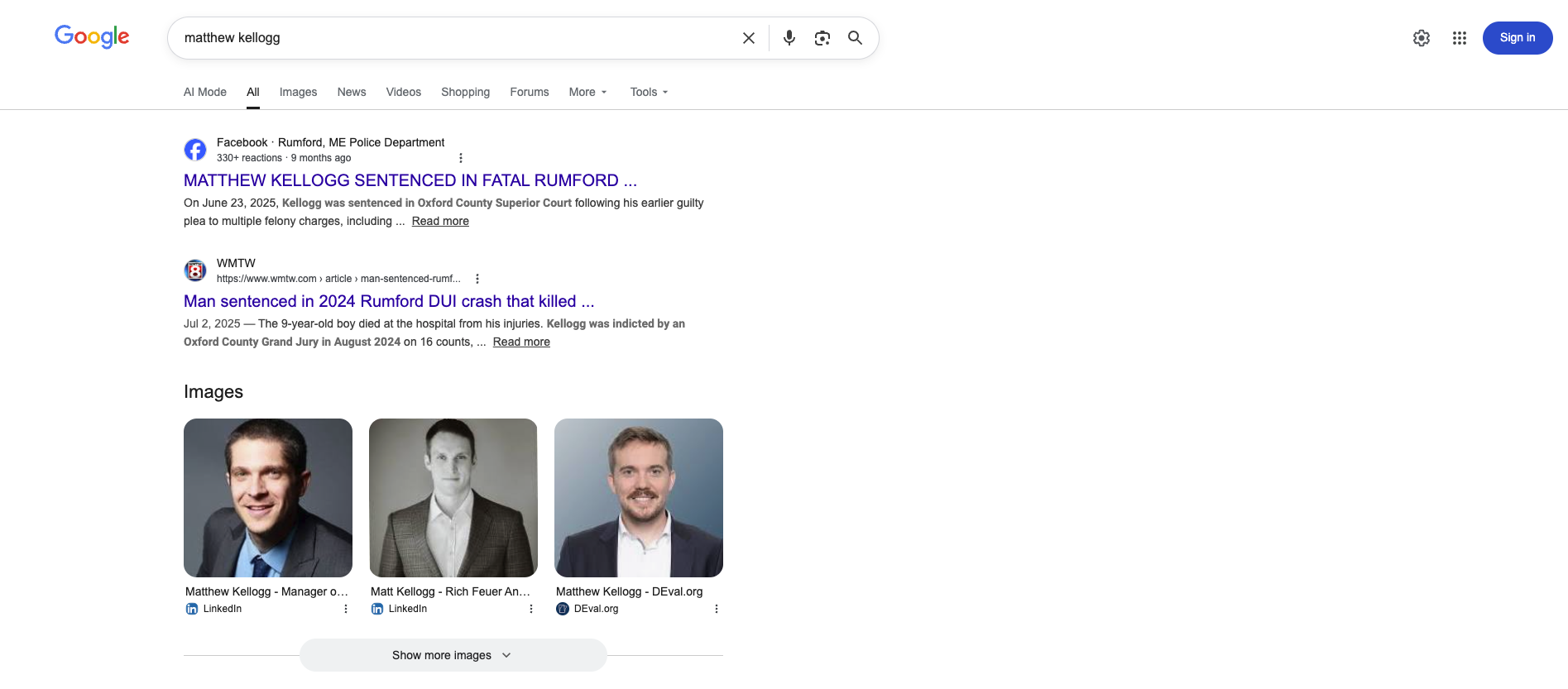
If you Google my name right now, the first result is a Facebook post about a man who went to prison for vehicular manslaughter, aggravated assault, and operating under the influence. The next three results are different news outlets covering the same case. None of them are me. We share a name.
Below those, the first page continues with public-records aggregators, name-match directories, and other generic listings. Of the ten results Google shows on the first page for my full name, exactly zero are properties I built, properties I control, or properties associated with me.
I am an SEO operator. I have eleven years of professional experience running an agency that handles clients nationwide. None of that shows up when someone searches my name.
The throne wasn’t mine. Someone else’s name, someone else’s story, owned my search results.
This page documents the work to take it back.
II. By design, not by accident
For eleven years, I built and held top rankings for clients across multiple industries. Court reporting at high monthly equivalent ad value. Answering services at national rankings. Top-three Google rankings on commercial keywords held year over year. The work compounded for clients who stayed engaged on month-to-month terms — a plastic surgery practice since 2017, an answering service since 2018, ongoing client engagements across multiple industries since 2021. Engagements running on years rather than months.
Throughout that decade, I did not build a personal brand. By design, not by accident. My time went to client work that produced measurable revenue for them. My own digital footprint was a non-priority. The math worked: client retention compounded, new client referrals came through the network, the practice did not need an external personal brand to keep operating.
The architect occupied the consultative-strategic position serving client strategic objectives — not the personal-brand-building position. Eleven years of compounding work for the clients. Zero years of compounding work for the architect’s own SERP.
The strategic decision now is different. The work the practice does for clients applies to the practice itself. The methodology is the same; the territory is mine.
2017
Plastic surgery practice
2018
Law firm
2020
Multi industry engagements
Present
Engagements continuing
The position
The work runs from the consultative-strategic Hand position — the architect of the practice’s system, coordinating across SEO, reputation management, and AEO in service to a prospect’s broader strategic objectives in their own domain. Eleven years occupying that position for clients across competitive commercial industries. The integrated engagement scope across all three disciplines coordinated simultaneously is what the practice calls The Court — when the strategic situation calls for the architect coordinating across all appointed forces rather than a single domain. This case study runs that integrated engagement on the operator’s own brand build, starting with reputation management as the entry point.
III. The math
My SERP happens to have both problems at the same time. The viral news story of a man with my name produced four negative results on the first page, and my own professional work — the agency, the client wins, the years of documented work — appears nowhere. This is unusual. The methodology that follows applies to either problem; mine is the harder demonstration because it requires solving both at once.
The math, sized to common professional service economics:
– A plastic surgeon at $20,000 average procedure value, losing one consultation per month to SERP friction, loses $240,000 annually
– An attorney at $50,000 average retainer, with relationships that frequently extend over multi-year engagements, loses comparable amounts compounded across the engagement length
– A wealth manager working with seven-figure account values, losing one account per year to a search experience that didn’t inspire confidence, loses millions over the relationship’s expected life
– A service business owner like me, on monthly retainers with annual or multi-year client tenure, loses orders of magnitude more than the apparent monthly value when a prospect doesn’t convert
The cost of a damaged SERP is rarely the kind of cost that wakes you up at night. It’s the kind that hides inside slightly-lower-than-expected close rates, conversations that don’t progress past the first call, prospects you assumed were just “not ready” who never come back. It’s a tax on every new piece of business, paid silently.
This is also why the problem disproportionately affects high-revenue professionals. Their incomes are large enough that the marginal loss doesn’t register on the P&L. They’re losing money they were never going to count, to a problem they don’t know exists.
I was losing money I wasn’t counting. I’m an SEO operator. If I missed it, almost everyone reading this is missing it too.
IV. The decision to fix it publicly
I could have fixed this privately. Most operators in my position would have. The methodology that follows works whether anyone is watching or not.
I decided to fix it publicly because the methodology is more credible when you can watch it work on the hardest possible case.
Most reputation management case studies are written after the work is done. Before-and-after screenshots, summary paragraphs, and a request that the reader take the agency’s word for it.
This case study works in the opposite direction. The work is being done in real time. The current state of my SERP is on this page, dated, with a third-party archive link. The methodology is documented at the architectural level. The movement log below tracks every change as it happens.
The trade-off is that I’m putting a reputation problem on display. Anyone who finds this page can verify the manslaughter result by opening a new tab and searching my name. If the methodology fails, the page documents that as readily as it would document success.
That trade is worth it.
The professional reading this has stood in the same place I’m standing — looking at a SERP that doesn’t represent them and wondering whether anything can be done about it. They’ve made the same calculation about whether to act publicly or quietly. They’ve seen agencies promise outcomes and deliver case studies that asked for trust rather than offering proof. The work documented on this page is the proof I would have wanted at that moment.
V. The methodology, at altitude
The methodology runs on four layers, each carrying a structural function in the architecture, each working in coordination with the others.
Layer one — controlled properties. The owned-domain layer. Personal sites and brand sites under direct ownership where on-page optimization, schema markup, structured content, and internal linking architecture can be controlled at canonical depth. A professional already has more web presence than they realize: practice and firm websites, partner bios, About-us pages, association directory listings, conference speaker pages, alumni profiles. The personal name domain is one piece of a larger inventory. Knowing which of these properties to activate, in what configuration, with what optimization signals, across which keyword variations — and how to make them work together rather than competing — is the work. The properties exist. Making them rank, durably, for the right combinations of search terms, is the discipline.
Layer two — high-authority social platforms layer. LinkedIn, Instagram, Facebook, YouTube, others — treated as ranking properties, not just social presence. Each platform carries enough domain authority to claim a top SERP slot for a personal name when configured correctly. Most professionals have several dormant or under-optimized accounts that could be ranking and aren’t. This layer turns those into active ranking properties.
Layer three — authority distribution. Strategic placement of name-anchored content across high-domain-authority surfaces, configured to rank for the name and feed authority back to the rest of the architecture. The mechanics stay private.
Layer four — supporting domains. Secondary properties that round out the SERP and provide defensive depth. SERPs are volatile, and the volatility runs in both directions. A recent client can leave a one-star review, justified or not, that lands on the first page. A competitor can publish content designed to harm the professional’s reputation, true or fabricated. A news outlet can pick up a story that has nothing to do with the work. Algorithm updates can promote results that previously sat on page two. Defending the SERP has to be active and ongoing, not one-time. Layer four is what makes the architecture survive what comes next.
Each layer reinforces the others. The owned property layer anchors the high-authority social platforms layer through internal linking. The authority distribution layer points back to both. The supporting domains close gaps and absorb volatility. Multiplied across each meaningful keyword variation a prospect might search, the work compounds quickly.
The work runs on documented cadence from the architect’s studio. Weekly ranking reports show every position movement across the keyword surfaces being built. Quarterly strategy reviews surface what shifted in the SERP landscape and where the architecture needs adjustment. Monthly is the renewal decision point — month-to-month engagement structure, no contractual lock-in, freedom to leave at any boundary. The cadence is what makes the architecture knowable rather than mysterious. The reader of the weekly report can see what moved, what didn’t, and what is queued next. The architecture is built in public to its own client; the chronicle below is the same artifact, pulled out for the audience reading this page.
The architecture is not a playbook. It’s a configuration the architect adjusts to the prospect’s specific SERP, specific competitive surfaces, specific industry-search-behavior patterns.
Compounding
The work compounds in ways that single-engagement engagements cannot capture. Ranking durability sustains across algorithm changes — the architecture absorbs updates the way it absorbs review volatility, with redundancy and depth rather than reaction. Cumulative content infrastructure value — the assets built in year one continue to produce ranking authority in year three, and the assets built in year three feed the assets built in year five. Cross-discipline orchestration matures across engagement-years — the reputation architecture interacts with the lead-generation architecture interacts with the answer-engine architecture, and the interactions tighten as the architect understands the prospect’s specific competitive surfaces more deeply over time. The clients running on month-to-month structure since 2017, since 2018, since 2021 are engagement-years compounding visibly: every year of retention is a year of architectural depth that newer engagements cannot replicate.
The trajectory of the work documented on this page mirrors the integrated build pattern that the practice runs for clients. Reputation management for the operator’s own name is the entry point — the work an established practice needs done before lead-generation has anywhere clean to land. SEO Architecture extends outward — the lead-generation surface where qualified prospects need to find the practice in the first place. AEO Architecture extends further — the answer-engine surface where AI-mediated discovery increasingly happens. Integrated cross-domain coordination across the brand family is the full scope. Inside the practice, this integrated engagement is named The Court — the canonical mode when the strategic situation calls for the architect coordinating across all appointed forces rather than for a single domain.
The case study trajectory is anti-fragile under skepticism. The prospect testing whether the multi-year engagement claim holds finds the answer is structural — month-to-month engagement structure, transparent reporting cadence, verifiable specifics across the credentials, no contractual lock-in. The prospect testing whether the methodology is real finds the answer on this page in real time, on the operator’s own SERP, on the hardest possible case. The architecture benefits from the test rather than degrading under it; the more the prospect probes, the more the architecture confirms.
VI. The chronicle
What follows is the chronicle from the studio — the work as it happened, week by week, across the months when the SERP changed.
Below is the live state of the work, updated as it happens. Each entry is dated. The current SERP is captured at the latest update.
Today's state — April 25, 2026
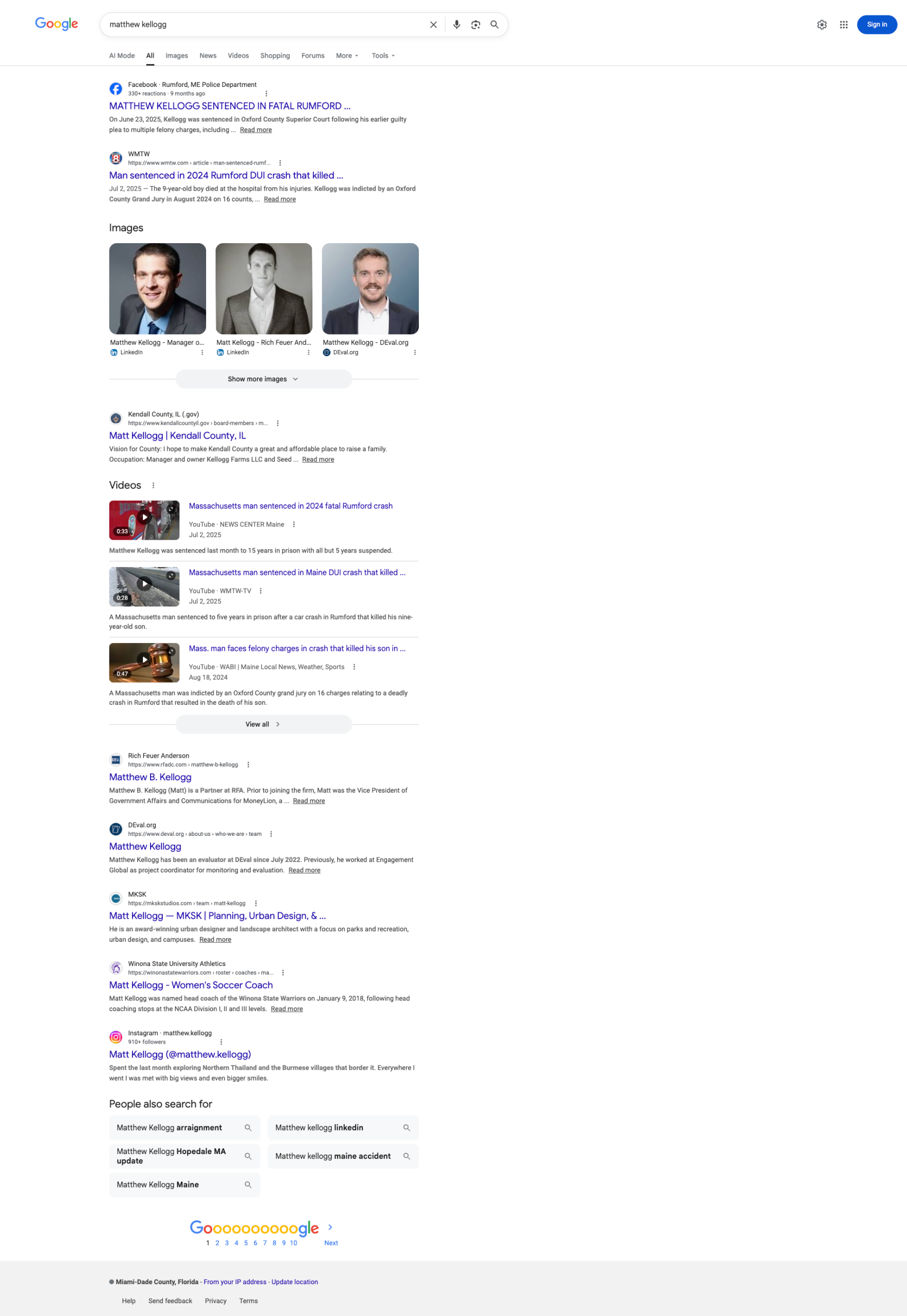
Above-the-fold view
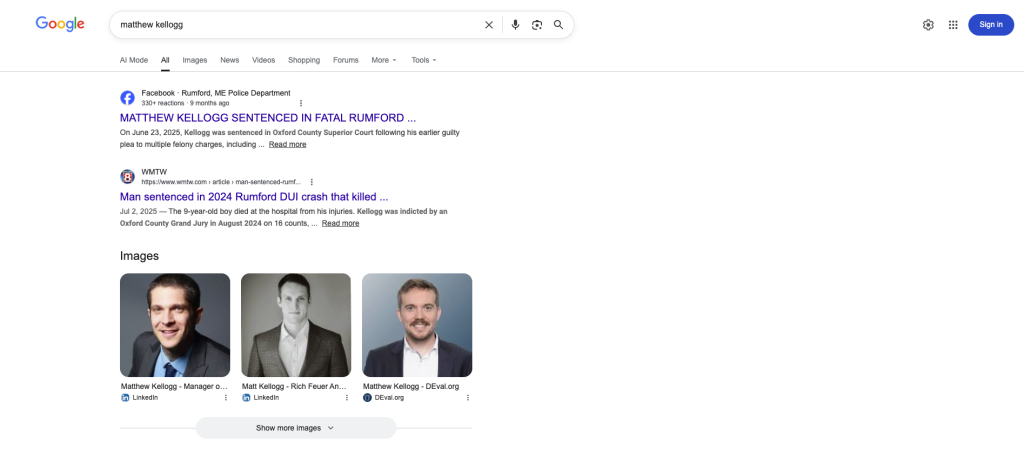
What page one currently shows:
- Position 1: Facebook post about a same-name man's vehicular manslaughter case
- Position 2,3,4: News outlets covering the same case
- Positions 5–8: Public-records aggregators and name-match directories
- Positions 9–10: Generic listings
Of ten results, zero represent the architect's deliberate work.
Log
-
April 25, 2026
Baseline state captured. SERP at moment of launch documented in Section I hero. Chronicle accumulates as work proceeds.
Defined end state
This case study is complete when every position on page one of Google for my full name is held by a property I deliberately built, optimized, or ranked as part of this work. The same standard applies to name + city and name + profession searches. The architecture is durable enough to absorb routine algorithm volatility without intervention.
Until then, this page is a work in progress. The chronicle is the proof.
VII. What this means for you
If you’ve read this far, you’re thinking about your own search results. You may have already opened a new tab and run the search.
What you saw is what your prospects see before they decide whether to hire you. Professionals who run this exercise often discover something unexpected — not always in what they find, but in what they don’t. The dentist who finds nothing about himself in his own results. The financial advisor whose first page is dominated by a same-name commodities trader in another state. The surgeon whose Healthgrades page auto-generated from one bad review three years ago and now sits in position three.
What you saw tells you which problem you have.
If your results were negative — bad reviews, news coverage, public records, anything that would give a prospect pause — you have a reputation problem in the most direct sense. The work in this case study is the work I’d do for you, scaled to your industry, your SERP severity, and the specific keyword variations your prospects use.
If your results were thin or empty — no real personal presence, mostly other people, generic listings, no consistent inbound footprint — you have a different version of the same problem. Your prospects can’t find you at all, which is its own kind of expensive. The mechanic is the same; the work goes in a different direction.
If your results were mixed — your owned properties ranking, but also negative results or same-name confusion in positions you’d rather control — the work is targeted suppression and ranking displacement at specific positions, with the architecture you already have as a foundation.
There’s also a fourth case. If your situation calls for the architect coordinating across reputation, lead generation, and AI-mediated search simultaneously — because the practice’s strategic objectives are integrated and the surfaces interact — the engagement scope is integrated rather than discipline-specific. The practice calls this integrated mode The Court. The fit depends on the scale of the practice (single-practitioner or boutique firm versus multi-practitioner large group), the timeline (the methodology compounds over 12-24 months minimum; faster engagement is not the right shape), and the strategic situation (whether the prospect is operating from a position where integrated counsel adds canonical depth vs. where a single discipline is the right scope).
VIII. The methodology applied
This case study documents the methodology applied to my own SERP. The same methodology applies to yours.
I will say it directly: the work is the same whether the prospect is me or a client. The architecture is configured to the specific SERP, the specific keyword variations a prospect’s audience uses, and the specific severity of the situation. The four layers operate at different intensities depending on what the prospect’s existing inventory looks like and what the SERP territory requires.
The chronicle below this section is the live proof. The methodology above this section is the same methodology I’d apply to your situation. The professional reading this has already done the math on what their SERP costs them. The remaining question is whether the methodology is real, and whether the architect doing it for me is the architect they’d want doing it for them.
That’s not the subject of this case study. But it’s worth mentioning, because the methodology you’re watching here scales in both directions.
The throne is yours when the search results for your name show what you want them to show. Take it. Defend it. The work is real, the methodology is documented, and the proof is on this page in real time.
Engagements are structured around the scope of work needed for your specific situation. Budget context is captured in the consultation form so we can discuss fit on the call.
If you want the same work done on your own search results,
Reserve consultation →